 Add to Chrome
 Add to Firefox
 Add to Edge
Internally Referenced Low-Light Enhancement
May 27, 2026
Self-supervised low-light image enhancement (LLIE) is highly appealing as it eliminates the reliance on external paired data. However, the lack of external references causes networks to struggle with decoupling entangled illumination, delicate textures, and amplified noise. To resolve this challenge, we propose an Internally Referenced LLIE framework that extracts reliable physical and structural references from the degraded input image itself. First, we introduce a local exposure-simulated scheme to extract a low-frequency pseudo ground-truth. This serves as an internal physical reference to guide global illumination estimation and correct color casts. Second, we propose a dual-domain preservation strategy with spatial and spectral constraints to construct internal structural references. Specifically, an Illumination-Aligned Perceptual loss preserves global structures under illumination shifts, while a Shift-Invariant Spectral Correlation loss captures fine-grained local structures and suppresses high-frequency noise. Finally, we propose a Gain-Adaptive Feature Modulation (GAFM) mechanism to address highly spatially-variant residual noise. By transforming the self-estimated illumination map into an internal spatial gain prior, GAFM dynamically guides a blind-spot network for spatially-aware denoising. Extensive experiments demonstrate that our method achieves state-of-the-art performance, delivering superior noise suppression and textural fidelity. Code will be publicly released at https://visonj.github.io/IRLE/.

Representative Attention For Vision Transformers
May 14, 2026Linear attention has emerged as a promising direction for scaling Vision Transformers beyond the quadratic cost of dense self-attention. A prevalent strategy is to compress spatial tokens into a compact set of intermediate proxies that mediate global information exchange. However, existing methods typically derive these proxy tokens from predefined spatial layouts, causing token compression to remain anchored to image coordinates rather than the semantic organization of visual content. To overcome this limitation, we propose Representative Attention (RPAttention), a linear global attention mechanism that performs token compression directly in representation space. Instead of constructing intermediate tokens from fixed spatial partitions, it dynamically forms a compact set of learned representative tokens to enable semantically related regions to communicate regardless of their spatial distance, by following a lightweight Gather-Interact-Distribute paradigm. Spatial tokens are first softly gathered into representative tokens through competitive similarity-based routing. The representatives then perform global interaction within a compact latent space, before broadcasting the refined information back to all spatial tokens via query-driven cross-attention. Via replacing coordinate-driven aggregation with representation-driven compression, RPAttention preserves global receptive fields while adaptively aligning token communication with the content structure of each input.RPAttention reduces the dominant token interaction complexity from quadratic to linear scaling with respect to the number of spatial tokens, while maintaining expressive global context modeling. Extensive experiments across diverse vision transformer backbones on image classification, object detection, and semantic segmentation demonstrate the effectiveness of our design.
NTIRE 2025 Image Shadow Removal Challenge Report
Jun 18, 2025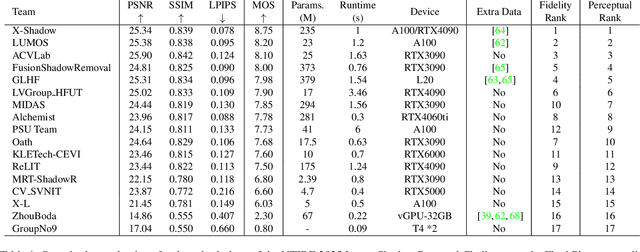

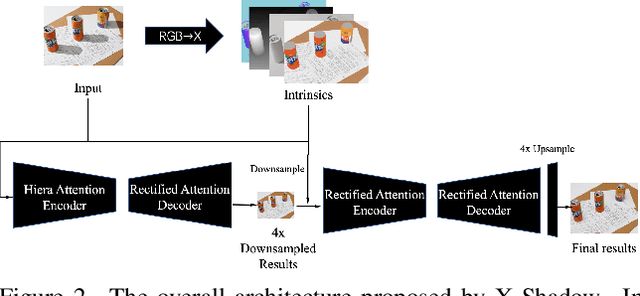

This work examines the findings of the NTIRE 2025 Shadow Removal Challenge. A total of 306 participants have registered, with 17 teams successfully submitting their solutions during the final evaluation phase. Following the last two editions, this challenge had two evaluation tracks: one focusing on reconstruction fidelity and the other on visual perception through a user study. Both tracks were evaluated with images from the WSRD+ dataset, simulating interactions between self- and cast-shadows with a large number of diverse objects, textures, and materials.
Regional Attention for Shadow Removal
Nov 21, 2024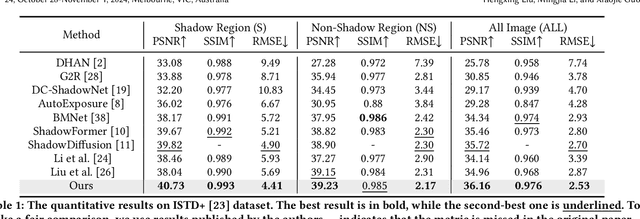
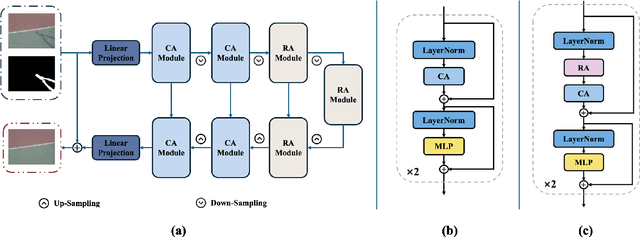
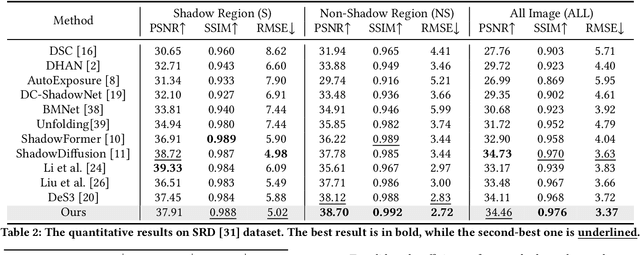
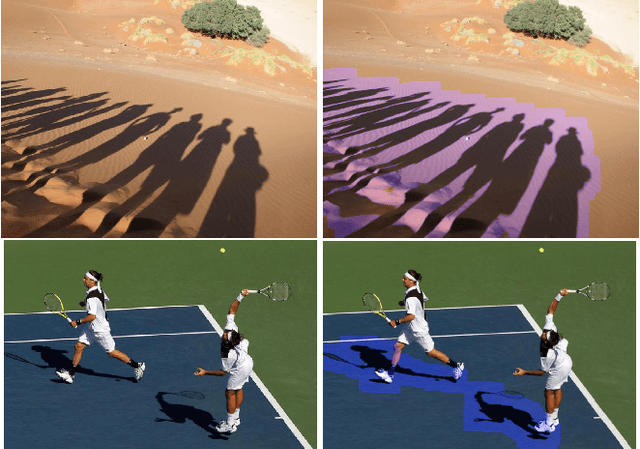
Shadow, as a natural consequence of light interacting with objects, plays a crucial role in shaping the aesthetics of an image, which however also impairs the content visibility and overall visual quality. Recent shadow removal approaches employ the mechanism of attention, due to its effectiveness, as a key component. However, they often suffer from two issues including large model size and high computational complexity for practical use. To address these shortcomings, this work devises a lightweight yet accurate shadow removal framework. First, we analyze the characteristics of the shadow removal task to seek the key information required for reconstructing shadow regions and designing a novel regional attention mechanism to effectively capture such information. Then, we customize a Regional Attention Shadow Removal Model (RASM, in short), which leverages non-shadow areas to assist in restoring shadow ones. Unlike existing attention-based models, our regional attention strategy allows each shadow region to interact more rationally with its surrounding non-shadow areas, for seeking the regional contextual correlation between shadow and non-shadow areas. Extensive experiments are conducted to demonstrate that our proposed method delivers superior performance over other state-of-the-art models in terms of accuracy and efficiency, making it appealing for practical applications.